Dispersion, Spectral Filtering, Subpixel Sampling
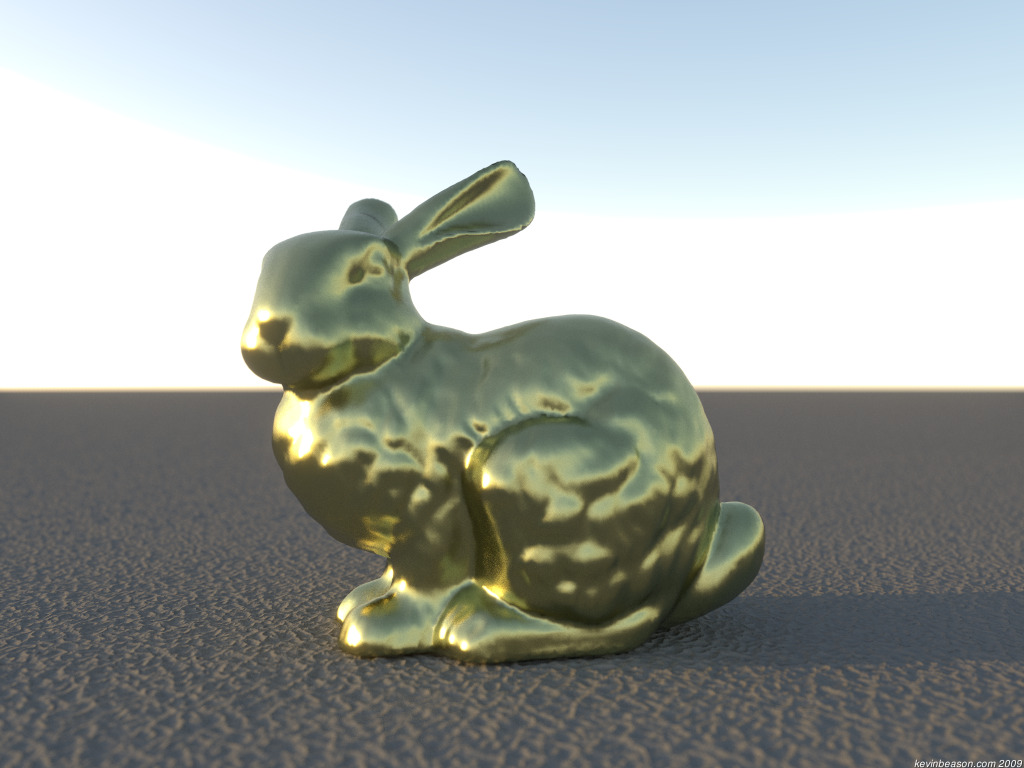
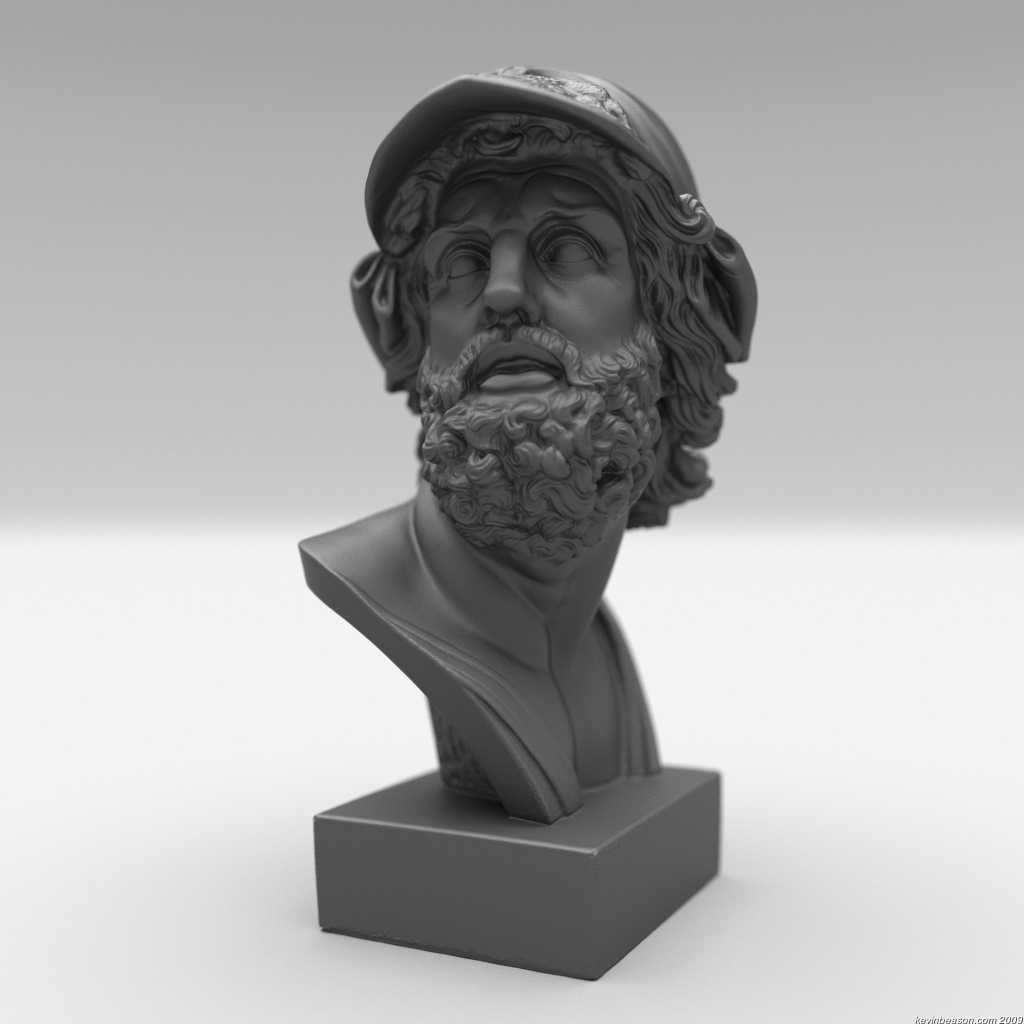

Bunny model available here. Ajax bust available here (thanks jotero!). Bunny scene was under 3 hours, Ajax scene was 8 hours.
The Cubo prism model is available here. For comparison, here is a proper rendering by luxrender. The prism shows off a new feature, spectral rendering. I used 20,000,000 photons which took about 1h20m to emit, and another 10 hours for rendering. (Without diffuse final gather it renders in about 2.5 hours.)
Dispersion in the glass is computed using Cauchy’s equation with dense flint glass (SF10) coefficients. Spectral computations are done in a way similar to this project, but with support for arbitrary wavelengths. I sample a wavelength from the visible spectrum and compute a “wavelength filter”, which is just an RGB color. I convert the CIE XYZ response for that wavelength to RGB and normalize such that a uniform sampling of the entire spectrum produces white (1, 1, 1) instead of (0.387463, 0.258293, 0.240652). Then I scale the emitted photon color and primary rays’ radiance by the normalized color. I sample the wavelengths with importance sampling according to the average CIE XYZ response.
With this spectral filtering I have to take more samples to eliminate the chromatic noise, but the result is consistent with the non-spectral result, provided there is no wavelength dependent reflection such as dispersion. That is, without dispersion, the spectral and non-spectral results match. If there is wavelength dependent reflection, then you get results like the prism image.
Finally, the cubo prism image and the last batch of sphere BRDF tests use subpixel sampling (similar to what’s done in smallpt). I divide each pixel up into 4×4 subpixels. Basically I scale the image resolution by 4, render, do all the tone mapping, and then shrink the image back down to the desired resolution using averaging. This produces much sharper results at the cost of increased memory usage. This is partially based on what Sunflow does, whose source I used as a guide, but without the adaptive anti-aliasing.
9 comments9 Comments so far
Leave a reply
Any reason you haven’t posted anything for six months?
No good reason, just been super lazy 🙁
So, you’re still working on Pane. That’s great! There’s lots of stuff here I’m planning for liar as well, but you know, progress is slow =)
About how much longer does it take to clean up the chromatic noise vs. a non-spectral render?
Another question: do you get much out of using the Sunflow technique of super-sampling if you use a pixel reconstruction filter other than the box (e.g. tent filter)?
How are you generating photons for the Cubo scene? Some kind of importance sampling? For me, 100,000,000 (random) photons wasn’t enough.
Also, how did you compute the dispersion coefficients? The original was 1.4+50.0/(w-230), but I curvefit this to Sellmeier. Coefficients are A=1, B0=0.940608, C0=0.061544, B1=0.220931, C1=0.061271, B2=-30.611816, C2=-262.595686, in case you’re interested.
Here is another duet with my dear friend Sönke Meinen during our tour in Germany. This is a piece composed by Sönke that I have adored for a while and had a blast composing a second part to it.
1 Zoom recorder,… …
Menurut salah satu kepala sekolah di Finlandia, Kari Kivinen, sangat penting untuk mengajarkan anak-anak berpikir kritis di tengah perkembangan arus media sosial. Salah satu hal lain yang perlu dipelajari dri dunia pendidikan di Finlandia ialah bagaimana pendidikan di negara terkait mengajari para siswa sekolah basis melawan kehadiran dan pengaruh berita Hoax. Tapi, beberapa bagian ya tambahkan informasi lain dari situs CDC dan bagian lain ya kurangi. Bagi saya, artikel berisi informasi penting tentang kesehatan bukan boleh dicampuri dengan opini perseorangan. Fenomena “googling” atau mencari informasi melaluimesin pencari informasi google sudah menjadi trend global, kalo boleh dikatakanmemuncak dalam satu dasawarsa terakhir ini; termasuk dalam dunia pendidikan. Pola konvensional dalam bentuk membaca buku perlahan-lahan, kalo pun tidakditinggalkan, mulai dinomor-duakan. Informasi yang ada dapat ditampilkan dalam bentuk tulisan, movement, grafis, foto, video, dan sebagainya. Homepage atau yang dalam kode Indonesia disebut sebagai beranda internet site merupakan sebuah halaman utama yg ditampilkan oleh suatu website. Mereka inilah yang seringkali bingung buat membuat website dan platform yg digunakan, kalau tidak terbiasa menyajikan website sudah pasti mereka jadi cari developer. 2 . Rajin cuci tangan kalau sudah kontak oleh orang lain, dekat dengan jamaah yang batuk-pilek pakai masker serta personal hygiene lainnya.
Undoubtedly, the heart of a prosperous SEO campaign is creating high quality backlinks to your website. Several services provide bulk link placement as a solution to increase the number of search-friendly backlinks with regard to specific keywords. Thes provide PAGE RANK of two to three and of course totally related content because the content of the content articles are related to the services that we offer. So , what should you choose between the 2? The two things which Google considers when deciding on the importance of a back-link or vote is the authority/trust plus relevancy which the backlink holds. And we are constantly berated to seek out these types of high ranking sites to get these to provide a backlink to our own websites. Don’t worry, here are some simple and best ways to earn them for the achievement of your SEO campaigns, so , have a look below and use them well. Over the off-chance, you are still confused; please consult your nearest SEO Company, which helps you in all the ways. SEOOne from the surest ways to attract traffic to your site is to have an organic SEO program.